Press Releases
IFAD and Japan’s MAFF connect sesame producers in Bangladesh with Japanese company Euglena
The International Fund for Agricultural Development (IFAD), the Ministry of Agriculture, Forestry and Fisheries of Japan (MAFF), Euglena Co., Ltd. (Euglena), and euglena GG Ltd. (Grameen Euglena) announced a new project to improve the lives of small-scale sesame producers in Bangladesh. This project will strive to achieve high quality of sesame seeds for Japanese companies through a “social procurement”*1 approach that aims to create positive societal and environmental impact.
The new initiative was announced today during the official launch of the new public-private-producer partnership supporting it at an event held at the United Nations University in Tokyo.
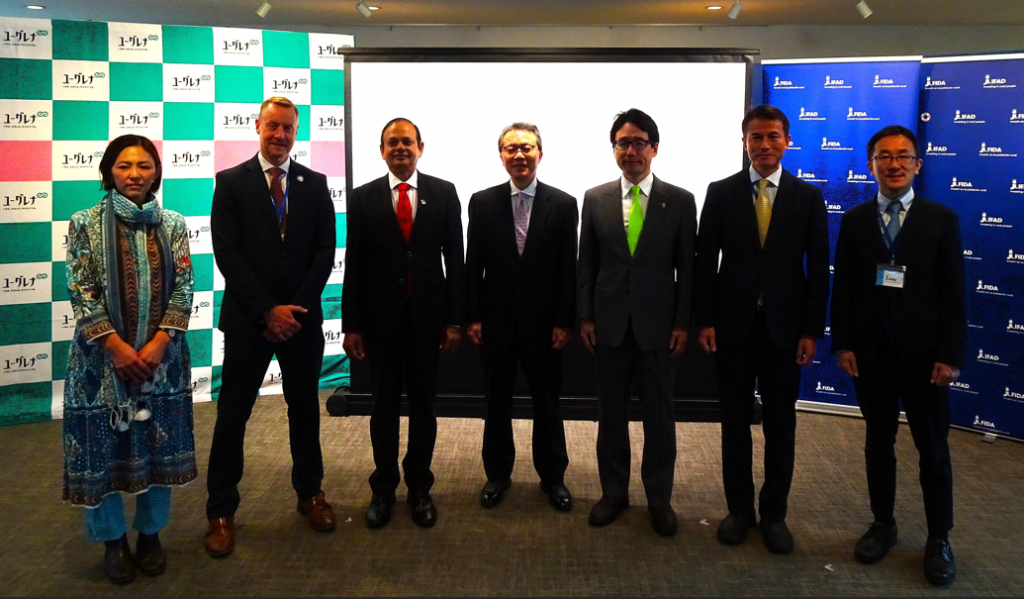
With the project “Strengthening Sesame Value Chain for Exports in Bangladesh”, all partners join forces to help increase both the quality of sesame seeds as well as the productivity of producers by enhancing cultivation practices and post-harvest handling capacities.
Starting in January 2026 in Bangladesh, where sesame presents significant opportunities to diversify agricultural exports, the third project*2 under the Enhanced Linkages between the Private Sector and Small-scale Producers (ELPS) Initiative will provide the adequate storage infrastructure and control equipment that sesame producers need to tackle key quality bottlenecks to access premium international markets.
IFAD’s Associate Vice-President, Donal Brown said: “Initiatives like ELPS particularly matter to us in IFAD, as the focus of our work is rural prosperity and small-scale producers are the backbone of rural economies – yet they often remain disconnected from lucrative markets. ELPS supports bridging this gap by creating public-private-producer partnerships (4Ps) that ensure smallholder farmers are not passive participants in value-chains but active partners in the system that brings food to your table. Through the initiatives supported by ELPS, we have seen successful model partnerships, where producers produce for higher-value markets, meet international standards, and earn price premiums,” in a video message broadcasted during the launch event.
“Today, MAFF and IFAD co-hosted the launch event, and I am pleased to see that the collaboration between MAFF and IFAD is progressing. I hope that those who contribute to building sustainable and resilient agri-food system and stakeholders like companies and producers will increase with harnessing ELPS initiative,” said Ken Sasaji, Deputy Director-General, Export and International Affairs Bureau of MAFF.
During the panel discussion, Mitsuru Izumo, Founder and President of Euglena said: “Since our founding, Euglena has been passionate about tackling social challenges in Bangladesh. Through efforts like delivering nutritious cookies to children and supporting local agriculture, we have worked to improve lives and promote sustainability. Drawing on over ten years of experience and networks built through Grameen Euglena, we are excited to take a new step toward realizing social procurement together with IFAD, MAFF, and local smallholder farmers. Through this project, Euglena and Grameen Euglena are committed to making a meaningful contribution to sustainable agriculture, better farmer incomes, and food security in both Japan and Bangladesh”.
Background
ELPS was launched by MAFF in collaboration with IFAD at the G7 Agriculture Ministers’ Meeting in Miyazaki in April 2023 in response to consumers worldwide demand for sustainability and environmental protection behind food they eat.
Through IFAD, a hybrid international financial institution and UN specialized agency, the initiative connects Japanese companies with small-scale producers in developing countries to support the development of sustainable supply chains. This feedback loop improves the productivity and safety of crops in developing countries, all the while it ensures that small-scale producers, who produce about one-third of the world’s food, improve their access to international markets.
Sesame seeds, sesame oil and sesame paste are commonly used in everyday cooking. However, in Japan, the self-sufficiency rate for sesame is less than 0.1%*3, with the vast majority of supply dependent on imports mostly from Africa. Given the supply risks associated with political, economic, and social conditions in producing countries, diversifying sourcing regions and enhancing traceability are critical challenges that must be addressed to ensure long-term stability.
About 35% of workers in Bangladesh are engaged in the agricultural sector and the sector plays a vital role in employment and land use. Despite its significance, the sector faces persistent challenges, including low productivity and limited export capacity. A substantial proportion of farmers are smallholders living in poverty. To address these issues, it is imperative to improve crop productivity and safety, while simultaneously fostering export market development through capacity building.
Project Overview
The project will support small-scale producers in rural Bangladesh through the following three pillars:
- Providing technical support for sesame producers to improve cultivation practices and post-harvest management to keep the seeds dry.
- Establishing facilities where producers keep their sesame before it is sold to buyers (decentralized aggregation hubs) with proper storage and quality control equipment.
- Enhancing market access by connecting producers with local exporters to increase farmers’ incomes.
*1 “Social Procurement” is a concept promoted by the Yunus Social Business and the World Economic From, which is defined as the process of companies buying goods or services from social businesses with the explicit intention of creating net positive societal or environmental impact through the company’s procurement function.
*2 The first ELPS project “Sustainable Coffee Production Project in Tanzania” was launched together with UCC Ueshima Coffee Co., Ltd. and Marubeni Corporation in September 2024. The second ELPS project “Macadamia Nut Value Chain Strengthening Project in Rwanda” was launched in August 2025 with Osti Japan Co., Ltd. and Rwanda Nuts Company Ltd.
*3 Based on MAFF import/export data (2023) and Japan Specialty Crops Seed Association (2023).